.webp)



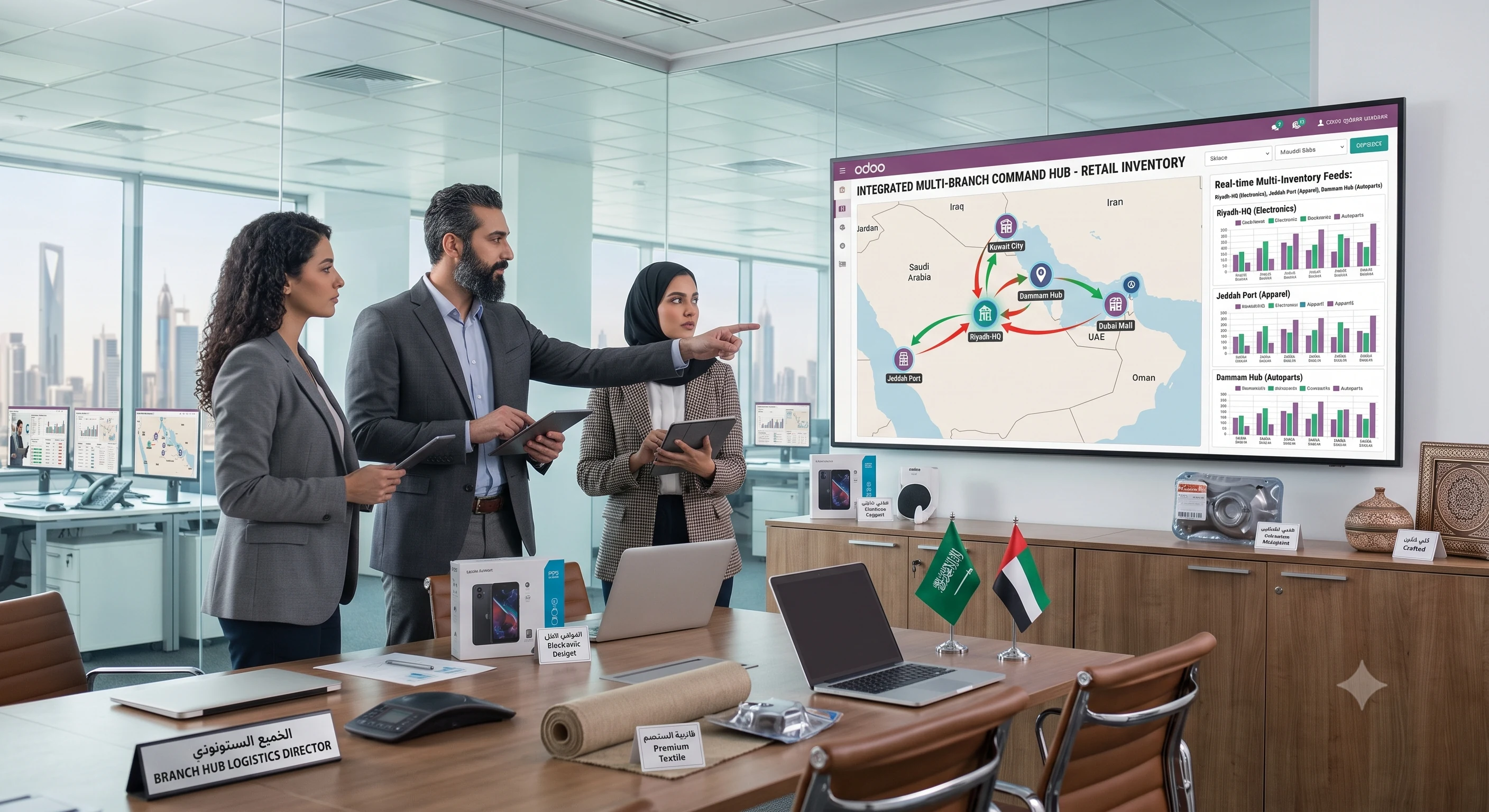
In multi-branch retail companies, the challenge is not only whether stock exists in branches, but whether inventory information is accurate and updated quickly across stores, warehouses, and management. Any mismatch between system data and reality leads directly to poor purchasing decisions, slower customer service, and higher inventory loss that becomes harder to trace later.
This is where Odoo proves its value as a unified platform connecting branches, warehouses, and management in one system, making stock movement visible in real time and easier to control and improve continuously.
Why Multi-Branch Inventory Management Breaks Down
In many cases, the problem is not lack of products, but inconsistent procedures across branches. One branch records a transfer immediately, another delays it. One team performs regular stock counts, another relies on infrequent reviews. The result is the same: the same product appears with different numbers in reports versus reality.
This inconsistency affects daily operations in several ways:
- Unexpected stockouts in one branch even though the same item exists elsewhere
- Delayed order fulfillment because internal transfers move too slowly
- Higher stock loss due to entry errors or weak movement tracking
- Difficult oversight when there is no unified view across branches
How Odoo Solves the Root Problem
1) One Operating Environment for All Branches
Odoo provides one central database for all branches, which means every sale, receipt, or transfer updates the same live system. This removes duplicate records and improves reporting reliability.
2) Clear Inter-Branch Transfer Workflows
Instead of manual handling, branch transfers can be managed through one defined process: transfer request, approval, shipment, receipt, and automatic quantity updates. This reduces internal transfer time and improves execution accuracy.
3) Real-Time Visibility for Management
Odoo dashboards provide live indicators such as branch stock levels, fast-moving items, slow-moving items, and open transfer requests. This gives management the clarity needed for faster and more accurate decisions.
Stock Control Tools That Make a Real Difference
Cycle Counting
Instead of waiting for one large annual count, Odoo supports regular cycle counts based on product importance or stock value. This helps detect discrepancies early before they turn into major losses.
Barcode Scanning
Using barcodes for receiving, issuing, and transfer operations reduces manual entry and speeds warehouse execution. It also lowers the risk of human error in reading item codes or quantities.
Movement Tracking and Audit Trails
It becomes easy to trace who performed each operation and when it happened, whether it was inside a branch or between branches. This raises governance quality and makes root-cause analysis much faster and more objective.
Direct Impact on Growth and Efficiency
When procedures are unified and branches are connected through Odoo, three core dimensions improve: operational accuracy, service speed, and management decision quality. Over time, this translates into lower loss, higher customer satisfaction, and improved profitability across the branch network.
Conclusion
In multi-branch retail companies, it is not enough for stock to simply exist in branches. There must be a system that guarantees data consistency, fast updates, and clear control. Odoo offers a practical framework that connects branches through one environment, simplifies transfers, and gives management real-time visibility into each branch’s performance. Combined with Stock Control tools such as cycle counting and barcode scanning, it significantly reduces loss and human error, making Odoo a strategic platform for growth and efficiency.
If you want to build a more accurate and flexible inventory operation for your branches, contact the GoCloud team to start a practical operational assessment tailored to your business.