.webp)



One of the most frustrating issues in trade and distribution companies is when reports say a product is available for sale while the warehouse insists it is physically unavailable. This mismatch does not just delay delivery or create tension between teams, it also damages management’s trust in the system itself. The recurring question is: is the problem with Odoo or any ERP system, or is the real cause much deeper?
What we repeatedly see in real projects is that the problem does not start with the software. It begins with inconsistent operating procedures across branches and departments. Once those inconsistencies enter the system, the result appears as conflicting numbers between sales and inventory.
How the Problem Starts Inside Trade and Distribution Companies
In many businesses, the same process is not performed the same way in every branch. One branch records stock transfers immediately, while another postpones them until the end of the day. One sales rep reserves stock inside the system, while another promises the customer verbally outside it. One team handles returns through a clear process, while another relies on quick improvisation. The result is always the same: the system records what was entered, but the operational reality follows a different path.
Once this happens, several problems begin to appear:
- Delivery delays because sales depend on inaccurate availability balances
- Stock count discrepancies between the system and actual warehouse reality
- Internal disputes between sales, inventory, and operations teams
- Unreliable reports that make management hesitate when making decisions
- More wasted time in manual checks and reconciliations
The Real Cause: Multiple Ways of Working, Not a Weak System
Successful Odoo implementation in trade and distribution does not depend only on system installation. It depends on standardizing how the company actually works. If there is more than one way to execute the same process, any ERP will simply reflect that disorder. That is why the better question is not: why did the system fail? It is: did we design a unified workflow before go-live?
In successful projects, we usually find that the roots of the problem come from one or more of the following:
- No unified workflow for sales, inventory, and transfers
- Weak timing discipline in how different branches record transactions
- Critical operations happening outside the system such as stock reservation, return handling, or quantity adjustments
- Excessively broad permissions that allow bypassing approved steps
- Insufficient training that pushes users back to old habits

How Odoo Solves the Problem Properly
The real value of Odoo is not only in recording transactions. It is in its ability to enforce a clear operational flow that connects departments and reduces individual workarounds. But this requires a proper implementation approach that starts with operational analysis, not with heavy customizations from day one.
1. Standardizing Workflow Across Branches
The first step is designing a clear workflow for sales, inventory, transfers, and returns, then enforcing it across all branches. Once the method becomes unified, the numbers become consistent too, and any deviation becomes easier to review immediately.
2. Activating Automatic Inventory Reservation
Instead of depending on verbal promises or unrecorded reservations, Odoo can reserve quantities automatically once a sales order is confirmed according to approved policies. This reduces the gap between what sales sees and what the warehouse sees.
3. Controlling User Permissions
One major cause of disorder is allowing too many users to perform sensitive actions outside the approved path. When permissions are structured and each step has a clear owner, errors decrease and operational discipline improves.
4. Tracking Warehouse Transfers in Real Time
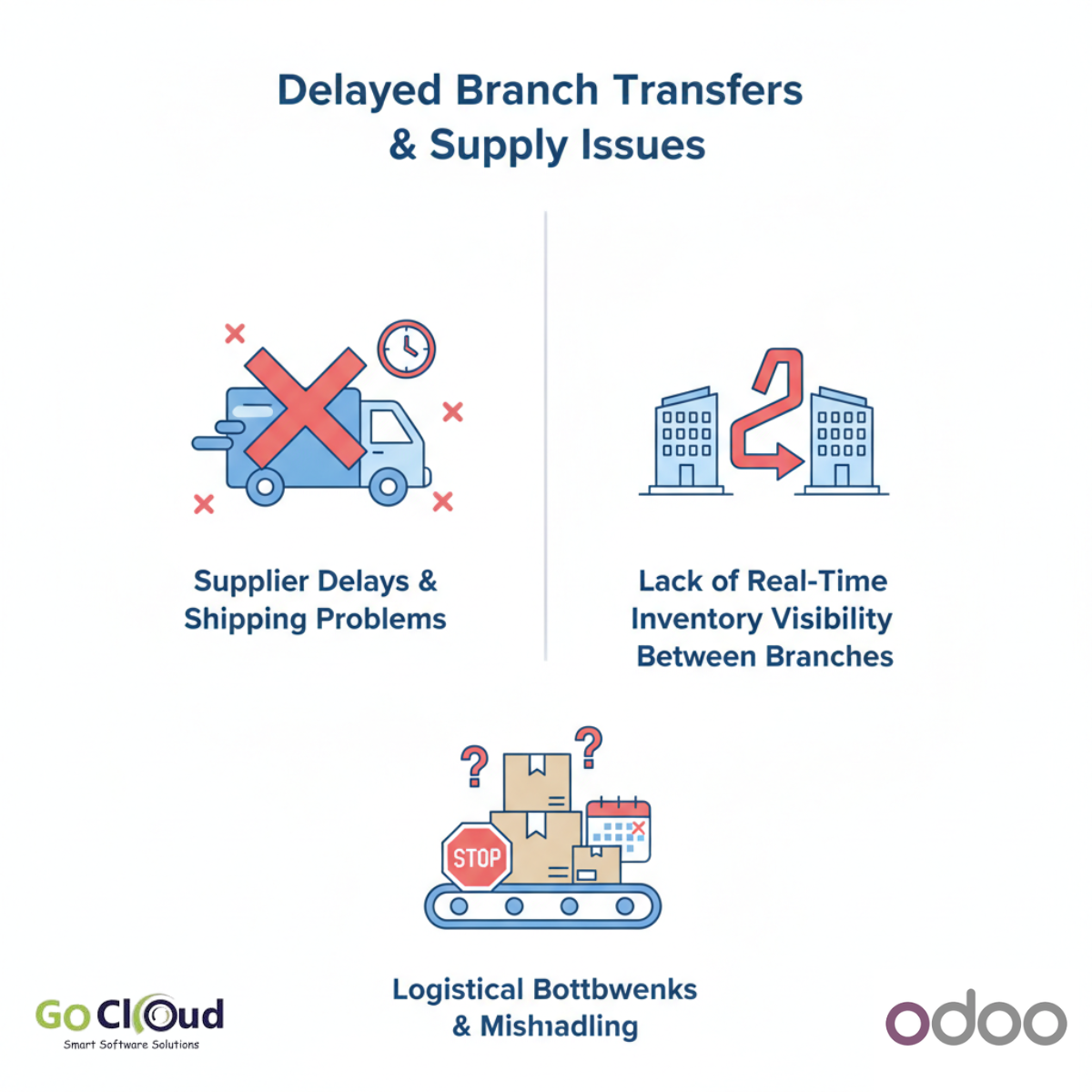
In multi-branch distribution companies, poorly controlled transfers are one of the biggest causes of stock discrepancies. Odoo provides clear transfer stages from request to shipment to receipt, with live visibility into each move’s current status.
5. Standardizing the Returns and Exchange Policy
If returns are handled differently from one team to another, inventory accuracy will suffer even if the sales process itself is controlled. That is why the policy must be clearly designed inside the system, defining when returns are accepted, how they are inspected, and where they are recorded.
6. Training Teams on the New Reality, Not Only on Screens
Many projects focus on showing screens and forget to explain the operational logic behind them. Effective training should answer one question: how does the employee now perform daily work inside the system step by step? When teams understand the reason behind the process, commitment becomes much easier.

What Results Can a Company Achieve After Fixing the Problem?
When Odoo is implemented using this methodology, the outcome becomes more than just a new system. It becomes a real operational improvement:
- Higher inventory accuracy and fewer differences between system records and reality
- Faster order fulfillment because sales teams rely on trustworthy numbers
- Fewer cross-department conflicts because everyone works from one source of truth
- Better purchasing planning based on more accurate data
- Greater management confidence in reports and stronger decision-making
When Is It a Serious Warning Sign?
If your company constantly sells unavailable products, struggles with delayed branch transfers, performs frequent manual reconciliations, or suffers repeated disputes between sales and inventory teams, these are not minor issues. They are strong indicators that the workflow itself needs redesign before you invest in more programming.
Conclusion
Differences between sales and inventory numbers in trade and distribution companies are rarely just technical errors. More often, they are a sign of deeper operational inconsistency. Odoo can solve this efficiently, but only when it is implemented as a tool to organize and standardize work, not just as a new interface placed on top of old chaos.
If you want more context on this topic, you can also read our article about improving the supply chain with Odoo. And if your company is struggling with the gap between inventory and sales or needs a practical workflow redesign that fits real operations, the GoCloud team can help assess the current state and build a more accurate, stable implementation.