.webp)



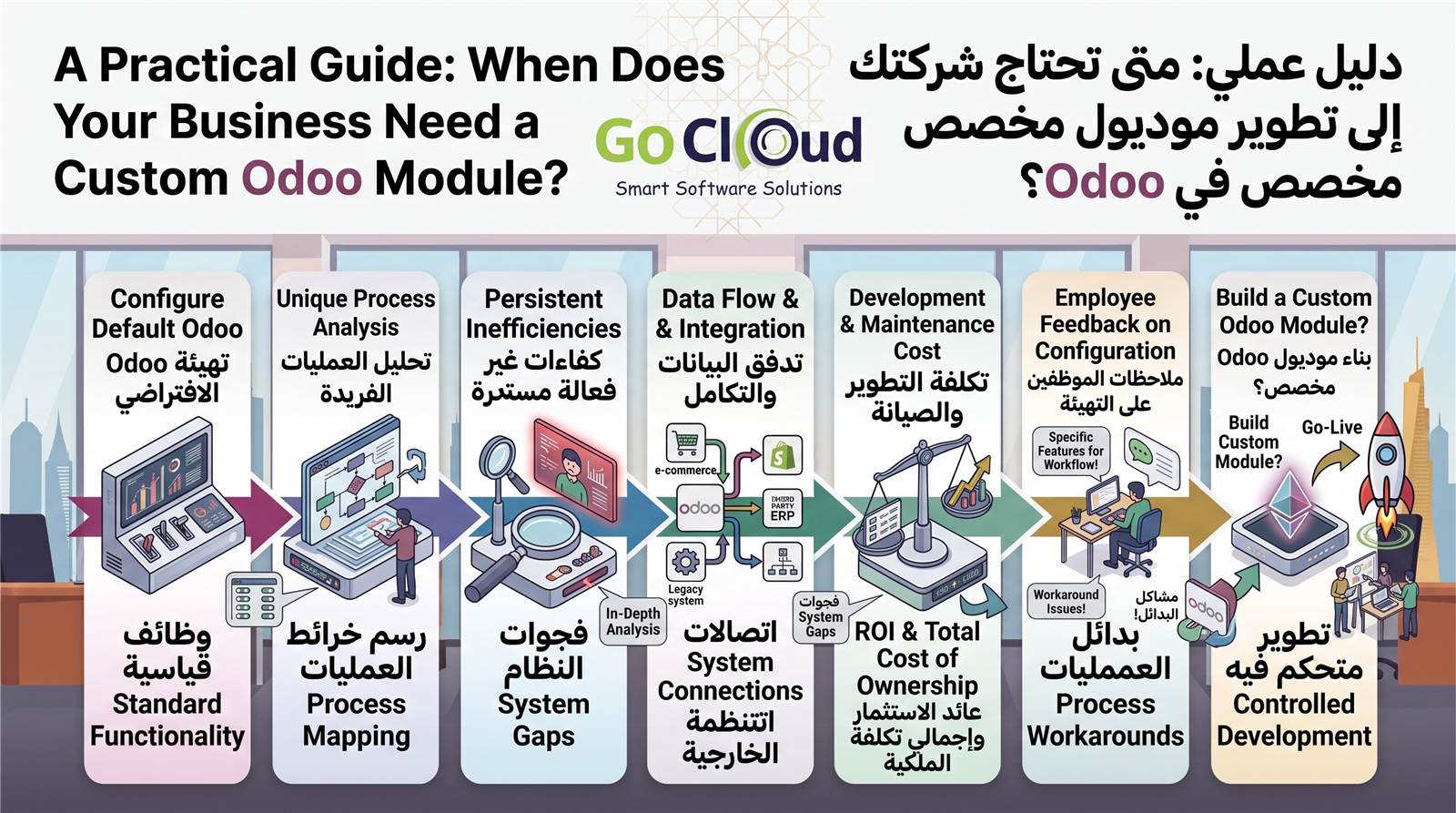
Odoo provides a broad suite of ready-made applications, but every business has operational details that set it apart: a special approval cycle, an unusual pricing method, or an integration with an external platform. This creates an important question: should you configure Odoo, use a lightweight customization, or build a custom module?
The right decision does not begin with code. It begins with the problem and the value of solving it. A well-designed custom module removes a real operational constraint while keeping the system stable, maintainable, and ready for future upgrades.
Configuration, Customization, Module, or Integration?
Before requesting development, identify the actual level of change:
- Configuration: using standard Odoo options to set permissions, stages, taxes, warehouses, and operating rules without writing code.
- Light customization: adding a field, report, view, or limited automation when the underlying business logic does not change.
- Custom module: developing a connected capability with its own rules, permissions, interfaces, and tests that can be installed and maintained independently.
- Integration: connecting Odoo to another system, such as a payment gateway, e-commerce store, shipping platform, attendance device, or government service.
If Odoo already provides the capability and it only needs correct configuration, rebuilding it in code adds cost and risk without adding value.
5 Signs a Custom Module Makes Business Sense
1) The Process Creates a Real Competitive Advantage
Your company may use a distinctive method for pricing, commissions, contract approval, or service delivery. If that process contributes to your competitive advantage and the standard workflow cannot support it, turning it into a module may be a justified investment.
2) Repetitive Manual Work Has a Measurable Cost
Copying data between spreadsheets, re-entering orders, and checking the same information in several systems are measurable warning signs. When development saves recurring hours and reduces errors, its return can be assessed clearly.
3) Compliance Requires Additional Controls
Some sectors require precise approval chains, mandatory audit records, granular permissions, or required documents before a transaction can move forward. General settings alone may not provide enough control.
4) An External Integration Is Central to Operations
If employees move data between Odoo and another system every day, an API integration may be more accurate and scalable than manual imports. A reliable design should also cover errors, retries, and synchronization monitoring.
5) Transaction Volume Has Outgrown the Temporary Solution
Spreadsheets and manual procedures may work initially, then slow down as branches, users, or transactions increase. When the workaround begins causing delays or weak oversight, it is time to create a structured workflow inside the system.
When Custom Development Is Not the Answer
A new module is rarely justified simply because users prefer the screen layout of a legacy system, because the team wants to preserve an inefficient procedure, or because no one has assessed an established standard application. A request used only once or twice a year may not justify ongoing development and maintenance either.
In these cases, process improvement, training, or standard configuration is usually better than turning every exception into permanent code.
How to Evaluate the Module Before Building It
Create a simple business case comparing the cost of the problem with the cost of the solution. Start with monthly manual hours, error and delay costs, and the effect on revenue or customer service. Then include analysis, development, testing, training, maintenance, and upgrade costs.
The practical decision is: will the expected value within a reasonable period exceed the total cost of owning the customization? Initial programming cost is only one part of that calculation because the module may need review when Odoo or the business process changes.
What a Strong Development Brief Should Include
- Describe the current problem and desired result in business terms, not only screen changes.
- Identify users, roles, permissions, and exceptions.
- Map the complete workflow and approval points.
- Define inputs, outputs, and required reports.
- Write testable acceptance criteria for each scenario.
- Assess the effect on accounting, inventory, sales, and connected applications.
This detail prevents mismatched expectations, supports accurate estimates, and turns testing into an objective process.
How to Avoid Over-Customization
- Use standard Odoo capabilities first and customize only the meaningful gap.
- Separate requirements into a minimum useful release and later improvements.
- Avoid changing the core directly; use independent modules whenever possible.
- Document code and configuration and test business-critical paths.
- Review compatibility and the upgrade plan before approving the design.
- Measure performance after launch to confirm that the expected value was achieved.
Conclusion: Customize What Creates Value
Your business needs a custom Odoo module when an important operational gap cannot be covered by standard applications or configuration and solving it has a measurable benefit. The best Odoo implementations are not the most customized; they achieve the right balance between standard capability and essential flexibility.
At GoCloud, we begin by analyzing the process and identifying the simplest sustainable solution. We then design the development, integration, and testing approach to keep the platform maintainable and ready to grow.